TikTok Engagement Rate Calculator: Measure Your Performance
Creating videos on TikTok is only one part of building a successful social media presence. Understanding how people interact with your videos is equally important. You might receive thousands of views on a video, but those views do not always translate into likes, comments, shares, or meaningful audience interactions.
This is where a TikTok engagement rate calculator becomes useful.
It helps you measure how effectively your content encourages viewers to interact with your videos. By entering your video views, likes, comments, shares, and other available engagement metrics, you can calculate an engagement percentage and better understand your content performance.
Whether you are a TikTok creator, influencer, digital marketer, social media manager, small business owner, or brand representative, tracking engagement rate can help you make more informed content decisions.
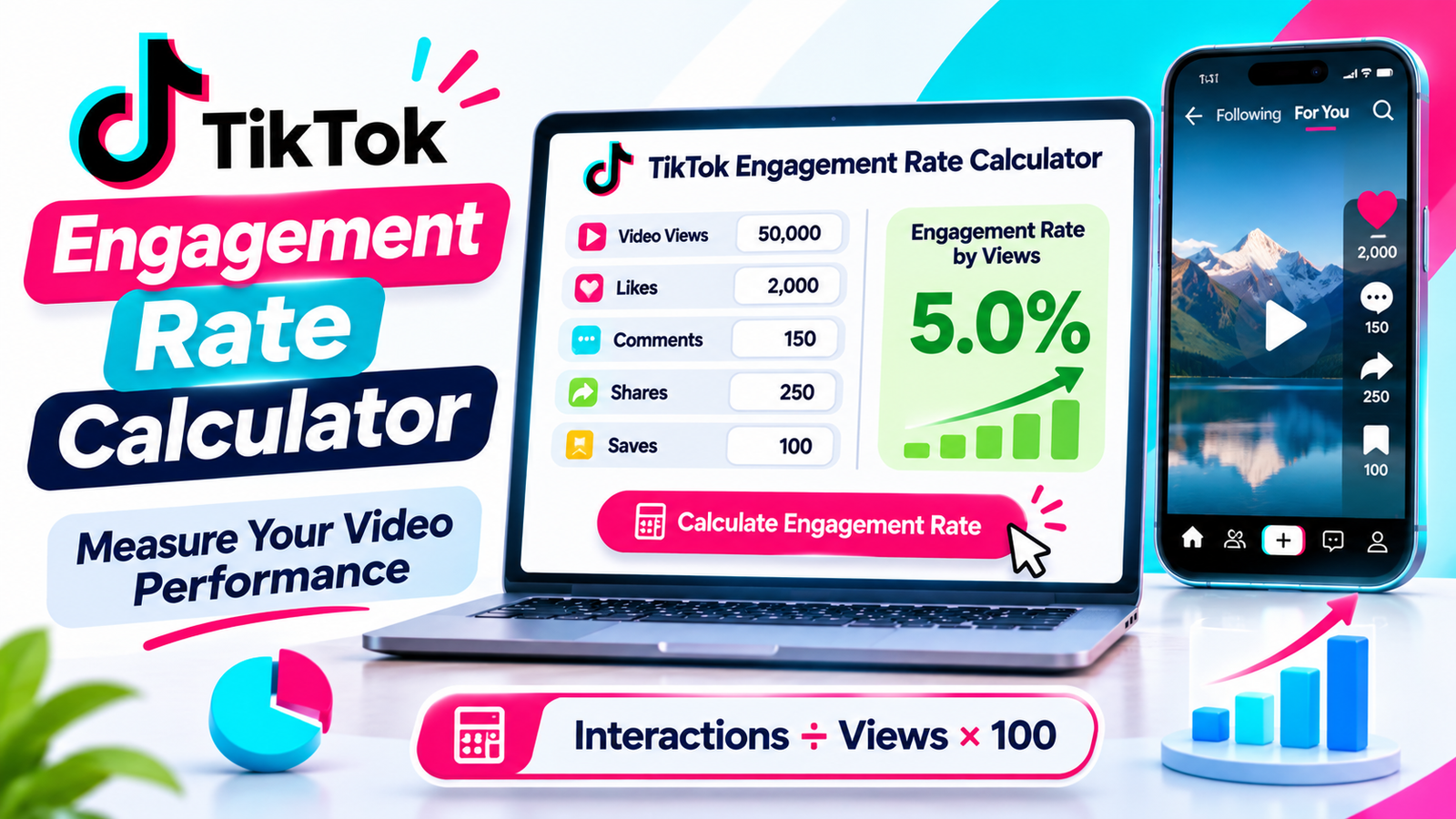
For example, imagine that one of your TikTok videos receives 50,000 views, 2,000 likes, 100 comments, and 250 shares. Although the video has attracted significant attention, you still need to understand how many of those views resulted in active interactions.
A TikTok engagement rate calculator helps turn these numbers into a percentage that is easier to evaluate and compare.
In this complete guide, you will learn how to calculate TikTok engagement rate, understand the different formulas, use an online engagement calculator, interpret your results, and identify opportunities to improve your video performance.
You will also discover current engagement benchmarks, practical examples for different industries, important TikTok analytics metrics, and common calculation mistakes to avoid.
What Is a TikTok Engagement Rate Calculator?
A TikTok engagement rate calculator is an online tool that measures the percentage of interactions generated by a TikTok video relative to a selected performance metric, such as video views or follower count.
It helps you understand whether viewers are simply watching your content or actively interacting with it.
Engagement usually includes actions such as:
Likes.
Comments.
Shares.
Saves or favorites, when included in the selected calculation method.
The exact calculation depends on the formula used by the calculator.
For example, a views-based engagement rate compares the total interactions on a video with its total views.
A follower-based engagement rate compares interactions with the creator’s follower count.
Both measurements can provide useful information, but they answer different questions.
A free TikTok engagement rate calculator makes these calculations easier by allowing you to enter your available statistics and receive a result without manually performing the mathematical operations.
Depending on the tool’s features, you may also be able to calculate average engagement across multiple videos, compare performance between posts, and evaluate different content strategies.
The main purpose is simple: help you understand how effectively your TikTok content encourages audience interaction.
Why Is TikTok Engagement Rate Important?
Views and followers are useful performance indicators, but they do not explain everything about your TikTok account.
A creator might have a large audience but receive relatively few comments or shares on individual videos.
Another creator might have a smaller following but attract meaningful discussions and interactions.
Engagement rate provides additional context by comparing audience interactions with views or another selected denominator.
Here are several reasons why this metric matters.
1. Measure Your Content Performance
Engagement rate helps you understand whether viewers respond to your videos.
For example, imagine two videos receive 20,000 views each.
The first video receives 500 interactions, while the second receives 1,500 interactions.
Although both videos receive the same number of views, their engagement rates are different.
The second video generates more interactions relative to its views.
This information can help you identify which topics, formats, and creative approaches deserve further testing.
2. Understand Audience Interest
People interact with videos for different reasons.
A useful tutorial might receive many saves, while an entertaining video might generate more shares and comments.
Reviewing these actions can help you understand which types of content your audience finds valuable.
Instead of focusing only on views, you can look at the complete interaction pattern.
3. Evaluate Influencer Performance
Brands often examine engagement metrics when evaluating potential influencer partnerships.
A creator’s follower count alone does not explain how actively their audience interacts with sponsored or organic content.
Engagement rate can provide another way to evaluate a creator’s performance.
However, it should not be used alone. Brands should also examine audience relevance, content quality, audience authenticity, average views, and campaign results.
4. Compare Different TikTok Videos
A calculator makes it easier to compare multiple videos using the same formula.
For example, you might discover that educational tutorials generate a higher views-based engagement rate than general entertainment videos.
You can use these observations to plan future content experiments.
5. Identify Changes in Performance
Your engagement rate may increase or decrease over time.
These changes can indicate shifts in audience interest, content quality, video topics, or distribution.
Monitoring performance consistently helps you notice patterns instead of reacting to the results of only one video.
6. Make Better Content Decisions
Engagement data can help creators identify which ideas deserve more attention.
For example, if practical tutorials consistently generate comments and saves, you might test a series of related educational videos.
If behind-the-scenes videos encourage more discussion, you could explore additional content in that format.
Use the results as evidence for experimentation rather than assuming that the same approach will always work.
7. Support Social Media Marketing Decisions
Businesses can use TikTok engagement metrics alongside website visits, leads, purchases, and other campaign outcomes.
A high engagement rate does not automatically mean a campaign generates sales.
However, the metric can help businesses understand how viewers respond to their content.
This makes it useful as one part of a wider marketing performance report.
How to Use Our Free TikTok Engagement Rate Calculator
Using a free TikTok engagement rate calculator is simple.
You do not need advanced mathematical knowledge or professional analytics software to calculate your engagement percentage.
Follow these steps.
Step 1: Select Your TikTok Video
Start by choosing the video you want to evaluate.
You can calculate the performance of an individual video or prepare statistics for several videos if your calculator supports account-level analysis.
For a single-video calculation, make sure all the numbers come from the same video.
Step 2: Enter Your Video Views
Enter the total number of views received by your selected TikTok video.
For example:
Video Views: 50,000
Views are used as the denominator when calculating engagement rate by views.
Step 3: Enter Your Total Likes
Enter the number of likes received by the video.
Likes provide one indication of how viewers respond to your content.
For example:
Likes: 2,000
Step 4: Enter Your Comments
Add the total number of comments received by the video.
Comments can provide useful information about audience discussion and interest.
For example:
Comments: 150
Step 5: Add Shares
Enter the number of times the video was shared.
Shares are particularly useful when evaluating whether viewers found a video interesting or relevant enough to pass along.
For example:
Shares: 250
Step 6: Include Saves or Favorites
If your calculator supports saves, enter the available number.
Saves can indicate that someone wants to return to the video later.
For example:
Saves: 100
Do not add a value for a metric you cannot reliably verify. Use the same interaction fields whenever you compare multiple videos.
Step 7: Enter Your Follower Count if Needed
If you want to calculate engagement relative to your audience size, enter your current follower count.
For example:
Followers: 10,000
This is optional when calculating a views-based engagement rate.
Step 8: Select the Calculation Method
Choose whether you want to measure engagement relative to video views or followers.
The views-based formula is generally more useful for understanding interaction relative to video consumption.
The follower-based formula is useful for comparing interaction volume with account audience size.
Step 9: Calculate Your Engagement Rate
Select the Calculate button.
The calculator uses your entered metrics to calculate the percentage.
Review the result and record the formula used.
Step 10: Use Your Result to Evaluate Performance
Once you have your result, consider the content topic, audience, video format, and publishing period.
Do not judge your entire account based on one video.
Compare several videos using consistent formulas and observation periods to identify more reliable patterns.
TikTok Engagement Rate Formula: How to Calculate It
Understanding the formula behind your calculator helps you interpret the result correctly.
There is no single universally standardized TikTok engagement rate formula for every reporting purpose.
However, engagement rate by views is a widely used approach for evaluating TikTok video performance.
1. Engagement Rate by Views
The views-based formula measures total interactions relative to video views.
Formula:
Engagement Rate by Views = (Likes + Comments + Shares + Saves) ÷ Video Views × 100
This formula is useful when you want to understand how many interactions a video generated relative to its views.
For example, suppose your TikTok video receives:
| Metric | Result |
| Video Views | 50,000 |
| Likes | 2,000 |
| Comments | 150 |
| Shares | 250 |
| Saves | 100 |
First, calculate total engagement:
2,000 + 150 + 250 + 100 = 2,500
Next, divide total interactions by video views:
2,500 ÷ 50,000 = 0.05
Finally, multiply by 100:
0.05 × 100 = 5%
Example Result: 5% Engagement Rate by Views
This means the video generated interactions equivalent to 5% of its total view count.
It does not mean that exactly 5% of unique viewers interacted with the video. Views can include repeat plays, depending on how the platform counts them.
2. Engagement Rate by Followers
Another commonly used formula measures interactions relative to your follower count.
This approach can help evaluate how a video performs in relation to the size of your existing audience.
Formula:
Engagement Rate by Followers = (Likes + Comments + Shares + Saves) ÷ Followers × 100
For example, imagine the following account statistics:
| Metric | Result |
| Followers | 10,000 |
| Likes | 2,000 |
| Comments | 150 |
| Shares | 250 |
| Saves | 100 |
First, calculate total interactions:
2,000 + 150 + 250 + 100 = 2,500
Now divide by followers:
2,500 ÷ 10,000 = 0.25
Multiply by 100:
0.25 × 100 = 25%
Example Result: 25% Follower-Based Engagement Rate
This means interactions on the selected video are equivalent to 25% of the account’s follower count.
It does not mean that 25% of your followers necessarily interacted with the video.
A video may also reach many people who do not follow the account, which is why follower-based and views-based rates can produce very different results.
3. Engagement Rate by Reach
Some analytics systems provide a reach metric representing the number of unique accounts that viewed content.
When reliable reach data is available, you can use it as another denominator.
Formula:
Engagement Rate by Reach = Total Interactions ÷ Accounts Reached × 100
For example:
Total interactions: 2,500
Accounts reached: 40,000
Calculation:
2,500 ÷ 40,000 × 100 = 6.25%
Example Result: 6.25% Reach-Based Engagement Rate
This measurement compares interactions with unique accounts reached rather than total video plays.
Use this method only when you have access to a suitable reach figure for the same video and reporting period.
Which Formula Should You Use?
The best formula depends on your objective.
| Formula | Denominator | Best Use |
| Engagement by Views | Video views | Measuring video interaction |
| Engagement by Followers | Follower count | Comparing audience-size-based performance |
| Engagement by Reach | Unique accounts reached | Measuring interactions relative to reach |
For most TikTok video performance reviews, engagement rate by views is a practical starting point.
For influencer comparisons, follower-based engagement may also be useful.
Always label the formula when sharing results with clients or comparing accounts.
What Counts as Engagement on TikTok?
Not every TikTok metric should be included in an engagement rate calculation.
Understanding which interactions count is important because different calculators may use different formulas.
Let’s look at the most common engagement metrics.
1. Likes
Likes are one of the most visible forms of interaction.
When viewers appreciate your video, they may tap the Like button.
For example, a travel creator might receive likes on a destination video because viewers enjoy the scenery.
Likes can help indicate audience response, but they do not explain every aspect of video performance.
2. Comments
Comments represent written responses from viewers.
They can include questions, opinions, feedback, and conversations about the content.
For example, a cooking creator might receive comments asking about ingredients or preparation methods.
Comments can reveal the topics viewers want to discuss.
3. Shares
Shares occur when viewers send or share your video with other people.
A useful tutorial, entertaining video, or informative demonstration may encourage viewers to share it.
Shares are worth tracking because they provide a different form of interaction from likes.
4. Saves or Favorites
Favorites allow viewers to save videos for later.
For example, someone might save a fitness workout, recipe, educational tutorial, or product guide.
When the metric is available, saves can provide additional information about the usefulness of your content.
However, not every reporting system includes saves in its engagement calculation.
5. Views
Views measure video playback activity.
They are especially important when calculating engagement by views.
However, views are the denominator in this formula, not an additional engagement interaction.
Adding views to likes, comments, shares, and saves would incorrectly mix exposure with interaction.
6. New Followers
A video may generate new followers.
This is a useful growth metric, but follower acquisition is usually better measured separately from engagement rate.
For example, you could calculate follow conversion by dividing new followers attributed to a video by its views, then multiplying by 100, when reliable video-level follow data is available.
7. Profile Visits
Profile visits show that viewers took an additional step after discovering your content.
They are useful for understanding interest in your account, but they should generally be tracked as a separate profile-conversion metric.
Important: For a consistent views-based calculation, use likes, comments, shares, and saves if available. Do not add views to the interaction total or switch between including and excluding saves when comparing results over time.
What Is a Good TikTok Engagement Rate in 2026?
One of the most common questions among creators is whether their TikTok engagement rate is good, average, or low.
The answer depends on several factors, including:
Account size.
Industry.
Content format.
Audience interests.
Video topic.
Calculation method.
Observation period.
There is no single percentage that guarantees good performance for every account.
A useful starting point is the latest available industry benchmark.
2026 TikTok Engagement Benchmark
Socialinsider’s 2026 TikTok benchmark report provides a useful reference for views-based engagement.
Its quarterly update reports an average TikTok engagement rate by views of 3.90% in Q3 2026, based on its analysis of approximately 40.7 million videos from 257,000 TikTok brand accounts.
The study’s views-based calculation includes likes, comments, shares, and saves divided by video views.
This is a benchmark for the particular dataset and methodology, not a guarantee of what every creator should achieve.
The report also provides 2025 engagement rates by follower-size category:
| TikTok Account Size | 2025 Engagement by Views |
| 1K–5K followers | 4.40% |
| 5K–10K followers | 4.00% |
| 10K–50K followers | 3.90% |
| 50K–100K followers | 3.75% |
| 100K–1M followers | 3.95% |
These figures illustrate why comparing accounts of different sizes can require additional context.
The report focuses on organic brand posts and does not represent every personal creator or industry.
Is a 1% TikTok Engagement Rate Good?
A 1% result may be worth investigating, but it cannot be judged accurately without knowing the formula and account category.
If the rate is calculated by views, compare it with relevant views-based benchmarks and your own historical results.
If it is calculated by followers, use follower-based benchmarks instead.
Never compare a follower-based rate directly with a views-based rate.
Is a 3% TikTok Engagement Rate Good?
A 3% views-based engagement rate can be a useful result.
It is close to the 3.90% Q3 2026 views-based benchmark reported by Socialinsider.
However, the comparison depends on the creator’s niche, account type, and interaction-counting method.
Is a 5% TikTok Engagement Rate Good?
A 5% views-based rate is above the 3.90% Q3 2026 reference point from Socialinsider.
That can indicate positive interaction relative to views.
However, one unusually successful video does not necessarily establish your normal account performance.
Review several comparable posts before making a long-term judgment.
Why Do Engagement Benchmarks Differ?
Different research companies use different datasets and measurement methods.
Some use followers as the denominator, while others use views.
They may also include different interaction types, reporting periods, industries, and account sizes.
For this reason, always read the methodology behind a benchmark before comparing it with your own calculator result.
TikTok Engagement Rate Examples for Different Creators
Understanding formulas becomes easier when you see how they work in different situations.
Below are practical examples.
These figures are illustrative calculations, not industry benchmark claims.
Example 1: Small TikTok Creator
Imagine a creator with 5,000 followers publishes a video that receives:
Views: 10,000
Likes: 600
Comments: 40
Shares: 60
Saves: 50
Total interactions:
600 + 40 + 60 + 50 = 750
Views-based engagement:
750 ÷ 10,000 × 100 = 7.5%
The video has a 7.5% engagement rate by views.
Example 2: Fitness Influencer
A fitness influencer publishes a workout tutorial.
The video receives:
Views: 80,000
Likes: 3,200
Comments: 160
Shares: 320
Saves: 320
Total interactions:
3,200 + 160 + 320 + 320 = 4,000
Views-based engagement:
4,000 ÷ 80,000 × 100 = 5%
The result is a 5% engagement rate by views.
For a fitness creator, saves may also be a useful supporting metric because viewers might want to revisit a workout tutorial.
Example 3: Food Creator
A food creator publishes a simple recipe video.
The video receives:
Views: 40,000
Likes: 1,500
Comments: 100
Shares: 200
Saves: 200
Total interactions:
1,500 + 100 + 200 + 200 = 2,000
Views-based engagement:
2,000 ÷ 40,000 × 100 = 5%
The result is a 5% engagement rate by views.
Example 4: Business Account
A small business publishes a product demonstration.
The video receives:
Views: 100,000
Likes: 2,500
Comments: 150
Shares: 250
Saves: 100
Total interactions:
2,500 + 150 + 250 + 100 = 3,000
Views-based engagement:
3,000 ÷ 100,000 × 100 = 3%
The business can review this result alongside product clicks, website traffic, enquiries, and sales.
A 3% engagement rate does not automatically indicate a successful sales campaign.
It measures interaction relative to video views, not purchases.
Example 5: Entertainment Creator
An entertainment creator shares a funny video.
The video receives:
Views: 250,000
Likes: 12,000
Comments: 800
Shares: 1,200
Saves: 500
Total interactions:
12,000 + 800 + 1,200 + 500 = 14,500
Views-based engagement:
14,500 ÷ 250,000 × 100 = 5.8%
The creator can compare this video with other entertainment videos to understand whether similar themes generate consistent audience interaction.
How to Find Your TikTok Engagement Statistics
Before calculating your engagement rate, you need accurate performance data.
TikTok provides analytics tools that allow creators and businesses to review content performance.
The exact interface can vary with account type, app version, and region.
Step 1: Open TikTok
Launch the TikTok application.
Make sure you are logged into the account you want to evaluate.
Step 2: Visit Your Profile
Tap Profile at the bottom of the screen.
This opens your account page.
Step 3: Open TikTok Studio
Tap the menu button in the upper-right corner.
Select TikTok Studio.
Step 4: Open Analytics
Find the Analytics section and open it.
The available sections may include overview, content, audience, or other performance categories.
Step 5: Review Individual Video Performance
Select the video you want to evaluate.
Open its analytics or More insights section, depending on the interface.
Review the available information, including video views and engagement metrics.
Step 6: Record Your Statistics
For your views-based calculation, record the metrics included in your chosen formula:
Likes.
Comments.
Shares.
Saves, if available.
Total video views.
Use the same video and observation period for all the values.
Step 7: Enter the Numbers Into the Calculator
Open the TikTok engagement rate calculator.
Enter the required statistics and calculate your result.
Keep a record of the result so that you can compare it with future videos.
Why Should You Track TikTok Engagement Over Time?
Calculating engagement once can be useful, but regular tracking provides more meaningful information.
A single video may perform unusually well because of its subject, timing, or distribution.
Looking at multiple videos helps you understand whether the result represents a consistent pattern.
1. Compare Weekly Performance
Review your latest videos once a week.
Record views, likes, comments, shares, saves, and engagement rates.
This allows you to identify changes in performance.
2. Compare Monthly Results
A monthly review can provide a broader view of your content strategy.
You might discover that certain content categories consistently generate more interactions.
3. Identify Your Best Content Format
Compare tutorials, demonstrations, entertainment videos, educational posts, and behind-the-scenes content.
Look for formats that produce meaningful audience responses.
4. Review Audience Growth
Track how many followers your videos generate alongside their engagement rates.
A video can receive a high engagement rate without generating many new followers.
Likewise, a viral video may attract many views without converting viewers into long-term followers.
5. Use Consistent Measurement Methods
Always use the same formula when comparing results.
If one month’s report includes saves and another does not, the comparison may become misleading.
Consistency is essential for meaningful tracking.
How to Improve Your TikTok Engagement Rate
Calculating your engagement rate is only the beginning.
The next step is understanding what your audience responds to and using that information to improve future videos.
Here are practical approaches to consider.
1. Create an Interesting Opening
The opening moments of a video should help viewers understand why they should continue watching.
Instead of beginning with a long introduction, show the main result, introduce a question, or explain the problem your video addresses.
For example, a cooking creator could start by showing the completed recipe.
A fitness creator could demonstrate the final exercise result before explaining the steps.
The opening should match the actual content rather than making exaggerated promises.
2. Understand Your Target Audience
Create videos that address your audience’s interests, questions, and problems.
For example:
A fitness audience may appreciate workout demonstrations.
A food audience may prefer practical recipes.
A technology audience may want useful tutorials and product explanations.
Understanding audience interests can help you choose more relevant topics.
3. Encourage Meaningful Comments
Ask questions that are naturally connected to your video.
For example:
“Which recipe would you try first?”
“Have you used this editing technique before?”
“Which destination should we explore next?”
Avoid repeatedly asking generic questions that do not add value.
4. Create Useful and Shareable Content
People may share videos that are informative, entertaining, relatable, or useful.
Think about what someone would gain by sending your video to a friend.
Examples include:
Quick tutorials.
Helpful demonstrations.
Practical tips.
Interesting discoveries.
Creative ideas.
Relatable experiences.
Focus on providing value rather than asking viewers to share every video.
5. Reply to Relevant Comments
Responding to genuine questions can help maintain conversations.
If someone asks how you created a particular video, consider explaining the process.
You can also turn common questions into future video ideas.
6. Experiment With Different Video Formats
Try different content formats within your niche.
For example:
A business could test product demonstrations, customer questions, behind-the-scenes videos, and educational content.
A creator could experiment with tutorials, storytelling, and short explanatory videos.
Compare the results using the same engagement calculation method.
7. Use Clear Captions
Your caption should provide useful context.
A short description can explain the subject and help viewers understand what the video contains.
Avoid writing captions that repeat the entire video without adding anything useful.
8. Use Relevant Hashtags
Choose hashtags that accurately describe the topic of your video.
Avoid using unrelated tags simply because they seem popular.
A hashtag generator can help you brainstorm ideas, but review the final selection before publishing.
9. Maintain Consistent Content Quality
Consistency does not mean publishing videos without considering quality.
Prepare a manageable publishing schedule that allows enough time for planning, recording, and editing.
It is better to maintain a realistic schedule than to publish additional videos that do not provide value.
10. Study Watch Time and Video Completion
Engagement rate is only one performance measure.
Average watch time and completion rate can help you understand whether viewers continue watching.
If viewers leave very early, review the opening and overall structure.
If they watch most of the video but rarely interact, consider whether the content encourages a natural response.
11. Experiment With Video Length
Different topics require different amounts of explanation.
A short tip may need only a few seconds, while a detailed tutorial may require a longer video.
Test different lengths and review performance rather than assuming that all videos should have the same duration.
12. Learn From Your Best-Performing Videos
Identify videos that perform consistently well.
Review their:
Topics.
Opening hooks.
Visual presentation.
Video length.
Captions.
Audience response.
Interaction patterns.
Use these observations to create new experiments without simply duplicating the same content.
13. Avoid Artificial Engagement
Buying followers, likes, or automated comments may make account statistics less meaningful.
Artificial interactions also create risks for your account and undermine the reliability of performance reporting.
Focus on genuine audience interest instead.
14. Review Analytics Regularly
Use TikTok Studio to monitor available video metrics.
Compare views, interactions, watch time, and audience information.
Do not depend on engagement rate alone when evaluating overall performance.
TikTok Engagement Rate Calculator vs. Manual Calculation
You can calculate engagement rate manually using a basic mathematical formula.
However, an online calculator can make repeated calculations more convenient.
| Feature | Manual Calculation | Online Calculator |
| Calculate total interactions | Manual | Automatic if supported |
| Calculate percentage | Manual | Automatic |
| Compare multiple videos | Requires a record | Depends on the tool |
| Check follower-based rate | Manual | Depends on the tool |
| Save results | Separate document | Depends on the tool |
| Time required | More effort | Usually quicker |
| Mathematical knowledge | Basic arithmetic | Minimal |
Manual calculations are useful when evaluating one or two videos.
An online TikTok engagement rate calculator is more convenient when you regularly review content or compare multiple performance results.
The best approach is to use a calculator for the mathematics while keeping a consistent record of the original metrics.
Common TikTok Engagement Rate Calculation Mistakes
Even when using an accurate calculator, incorrect input values can produce misleading results.
Here are some common mistakes to avoid.
1. Using the Wrong Denominator
The views-based and follower-based formulas measure different things.
Do not use views in one calculation and followers in another while treating the results as directly comparable.
2. Adding Views to Total Engagement
Views represent video exposure, not an interaction in the standard views-based formula.
The numerator should contain the selected interaction metrics.
3. Counting Saves Inconsistently
Some methods include saves, while others use likes, comments, and shares only.
Choose a consistent method and label it clearly.
4. Using Statistics From Different Videos
All values should relate to the same video when calculating an individual video’s engagement rate.
Combining likes from one video with views from another produces an incorrect result.
5. Comparing Different Reporting Periods
A video measured after one day may have fewer interactions than the same video measured after two weeks.
Allow a consistent observation window when comparing posts.
6. Confusing Views With Unique Viewers
Video views are not necessarily the same as the number of unique individuals who watched the video.
Repeated plays can affect the views-based calculation.
7. Looking Only at One Video
One unusually successful or unsuccessful video may not represent your normal content performance.
Compare a reasonable group of recent posts.
8. Ignoring Account Size
Follower count can influence comparisons between accounts.
When evaluating creators, consider both follower-based and views-based engagement where appropriate.
9. Treating a High Rate as Guaranteed Business Success
A high engagement rate does not automatically mean a video produces sales or leads.
Track conversions separately when evaluating business results.
10. Ignoring the Original Data
A calculator cannot independently verify your TikTok statistics unless it connects to an authorized data source.
The accuracy of a manually entered result depends on the numbers you provide.
How to Calculate Average TikTok Engagement Rate Across Multiple Videos
Calculating engagement for a single video is useful, but creators often need to evaluate their overall account performance.
There are two common ways to calculate an average across several videos.
Method 1: Average the Individual Video Rates
First, calculate the views-based engagement rate for each video.
Then add the individual rates and divide by the number of videos.
Formula:
Average Engagement Rate = Sum of Individual Video Engagement Rates ÷ Number of Videos
For example:
| Video | Engagement Rate |
| Video 1 | 4% |
| Video 2 | 5% |
| Video 3 | 6% |
Calculation:
(4% + 5% + 6%) ÷ 3 = 5%
The average engagement rate across the three videos is 5%.
This method gives each video equal weight, regardless of how many views it received.
Method 2: Calculate a Combined Engagement Rate
You can also combine all interactions and all views across the selected videos.
Formula:
Combined Engagement Rate = Total Interactions Across Videos ÷ Total Views Across Videos × 100
For example:
| Video | Views | Interactions |
| Video 1 | 10,000 | 500 |
| Video 2 | 20,000 | 800 |
| Video 3 | 70,000 | 2,100 |
| Total | 100,000 | 3,400 |
Calculation:
3,400 ÷ 100,000 × 100 = 3.4%
The combined engagement rate is 3.4%.
Which Method Is Better?
Neither method is universally better.
The arithmetic average gives every video the same importance.
The combined calculation gives more weight to videos with more views.
For account-level reporting, label which method you used and apply it consistently.
Do not compare an arithmetic average with a combined rate as though they were identical measurements.
How Businesses and Brands Can Use TikTok Engagement Rate
TikTok engagement rate is useful for businesses because it provides additional context about audience interaction.
However, businesses should connect engagement data with their actual marketing goals.
For Ecommerce Businesses
Online stores can use engagement rate to evaluate product demonstrations, product comparisons, and educational videos.
For example, a clothing store might compare videos showing different styling ideas.
The business can review interaction rates alongside product clicks and purchases.
For Influencer Marketing
Brands can calculate engagement rates when comparing creators for potential partnerships.
They should also examine audience quality, content relevance, average views, historical sponsorship performance, and campaign objectives.
For Local Businesses
Restaurants, salons, fitness studios, and local shops can evaluate the response to their TikTok content.
A restaurant might compare recipe videos, food demonstrations, and customer experiences.
The business can use these findings to guide future content planning.
For Digital Marketing Agencies
Agencies may manage several TikTok accounts simultaneously.
A consistent engagement reporting method makes it easier to compare results across clients and campaigns.
However, different industries should be evaluated using suitable benchmarks.
For Personal Brands
Coaches, educators, consultants, and professional creators can use engagement data to understand whether their content connects with their intended audience.
They can also track profile visits, enquiries, and other actions separately.
Frequently Asked Questions About TikTok Engagement Rate Calculator
1. What is a TikTok engagement rate calculator?
A TikTok engagement rate calculator is an online tool that measures audience interactions relative to video views or follower count.
It helps creators and businesses understand how effectively their content encourages likes, comments, shares, and saves.
2. Is there a free TikTok engagement rate calculator?
Yes. You can use a free TikTok engagement rate calculator to calculate your engagement percentage using available video statistics.
Enter the required metrics, select the calculation method, and review the result.
3. How do I calculate my TikTok engagement rate?
For a common views-based calculation, add likes, comments, shares, and saves if available.
Divide the total interactions by video views and multiply by 100.
For example, 2,500 interactions on 50,000 views produce a 5% engagement rate.
4. What is the TikTok engagement rate formula?
A commonly used formula is:
Engagement Rate by Views = (Likes + Comments + Shares + Saves) ÷ Views × 100.
Some calculators use a follower-based formula instead.
Always check the calculation method before comparing results.
5. What is a good TikTok engagement rate?
There is no universal engagement rate that applies to every account.
Socialinsider reported a 3.90% average views-based engagement rate for Q3 2026 in its brand-account dataset.
However, your own industry, account size, and calculation method should be considered when interpreting the result.
6. Is a 5% TikTok engagement rate good?
A 5% views-based engagement rate is above the 3.90% Q3 2026 reference point reported by Socialinsider.
It may indicate positive interaction relative to video views.
Compare several videos before treating it as your normal account performance.
7. Does TikTok provide an official engagement rate?
TikTok provides analytics and interaction metrics, but there is no single universally standardized engagement-rate formula used for every reporting purpose.
Creators and third-party tools calculate engagement using selected metrics and denominators.
8. Do views count as engagement?
Views indicate video playback and are generally used as the denominator in a views-based engagement rate.
They should not be added to likes, comments, shares, or saves when calculating the interaction total.
9. Do saves count toward TikTok engagement rate?
Some engagement-rate formulas include saves or favorites, while others do not.
If you include them, use the same definition whenever you compare videos.
10. Should I calculate engagement by views or followers?
Use views when evaluating how viewers interact with a video.
Use followers when comparing interactions with account audience size.
The correct method depends on your reporting objective.
11. Can I calculate engagement rate for one TikTok video?
Yes. You can calculate the engagement rate of an individual video using its own views and interaction statistics.
Make sure every input belongs to the same video.
12. Can I calculate average engagement rate for my TikTok account?
Yes. You can calculate an average across individual video rates or combine total interactions and total views across several videos.
These methods produce different results, so identify the method you choose.
13. Why is my TikTok engagement rate low?
A lower rate may reflect differences in audience interest, content topics, video format, views, or interaction patterns.
Review several videos and compare similar content before deciding what needs improvement.
14. Does a higher TikTok engagement rate mean more followers?
Not necessarily.
Engagement rate measures interactions relative to a selected denominator.
Follower growth is a separate outcome. Track new followers alongside your engagement results.
15. Does engagement rate affect TikTok video performance?
Engagement metrics provide useful information about how audiences respond to content.
However, TikTok recommendations involve multiple factors. Engagement rate alone does not determine whether a video will be recommended.
16. How often should I calculate TikTok engagement rate?
For regular content reviews, calculating engagement weekly or monthly can help identify patterns.
Use consistent reporting periods and compare similar types of videos.
17. Can brands use a TikTok engagement rate calculator?
Yes. Brands can use it to evaluate content performance and compare creators.
They should also examine audience relevance, authenticity, campaign results, and business outcomes.
18. Can I use an engagement rate calculator for influencer marketing?
Yes. It can help evaluate how much interaction a creator receives relative to views or followers.
However, engagement rate should be considered alongside average video views, audience quality, niche relevance, and previous sponsored content performance.
19. Why do different TikTok calculators show different results?
Calculators may use different formulas, interaction types, and denominators.
One may include saves, while another counts only likes, comments, and shares.
Others may divide engagement by views or followers.
Compare the formulas before comparing the percentages.
20. Can a viral TikTok video have a low engagement rate?
Yes. A video may receive a large number of views but a relatively small number of interactions.
This can result in a lower views-based engagement rate even when the video has significant reach.
21. Does TikTok engagement rate include profile visits?
Profile visits are generally tracked separately from standard video engagement calculations.
They can provide additional information about whether viewers are interested in exploring your account.
22. Can I improve TikTok engagement without buying followers?
Yes. Focus on relevant content, clear video openings, useful information, audience interaction, and consistent experimentation.
Artificial followers and interactions do not provide a reliable foundation for measuring genuine audience interest.
23. What is the difference between engagement rate and engagement count?
Engagement count represents the total number of selected interactions.
Engagement rate expresses those interactions as a percentage of views, followers, or another selected denominator.
For example, 2,500 interactions on 50,000 views produce a 5% views-based rate.
24. Can I compare TikTok engagement with Instagram engagement?
You can compare engagement metrics across platforms, but the formulas, audiences, and platform behaviors may differ.
Use clearly labeled formulas and appropriate industry benchmarks to avoid misleading comparisons.
25. Is a TikTok engagement rate calculator useful for beginners?
Absolutely. Beginners can use an online calculator to understand basic performance metrics without manually performing calculations.
It is a practical way to learn how views, likes, comments, shares, and saves relate to one another.
Final Thoughts
Understanding how people interact with your TikTok videos is an important part of building a more effective content strategy.
A TikTok engagement rate calculator helps you measure audience interaction relative to video views or follower count, giving you a clearer picture of how your content performs.
Whether you are a beginner, influencer, business owner, or professional marketer, calculating engagement can help you identify useful content patterns, compare video performance, and make more informed decisions.
Remember to select the right formula, enter accurate statistics, and use consistent measurement methods.
Do not focus only on one video or a single percentage. Review your results over time and consider other important metrics such as watch time, completion rate, audience growth, and conversions.
Most importantly, concentrate on creating original and relevant videos that give viewers a reason to interact.
Ready to measure your TikTok performance?
Try our free TikTok engagement rate calculator, enter your video statistics, and discover how effectively your content engages its audience.
Further Reading and Research Sources
TikTok Newsroom – TikTok Analytics.
TikTok Help Center – Comment Insights on TikTok.
Hootsuite – How to Boost TikTok Engagement: Tips and Free Calculator.
Hootsuite – How to Calculate Engagement Rate in 2026.
Socialinsider – 2026 TikTok Engagement Benchmarks.
Search Engine Land – TikTok Engagement Rate Calculator and Formulas.